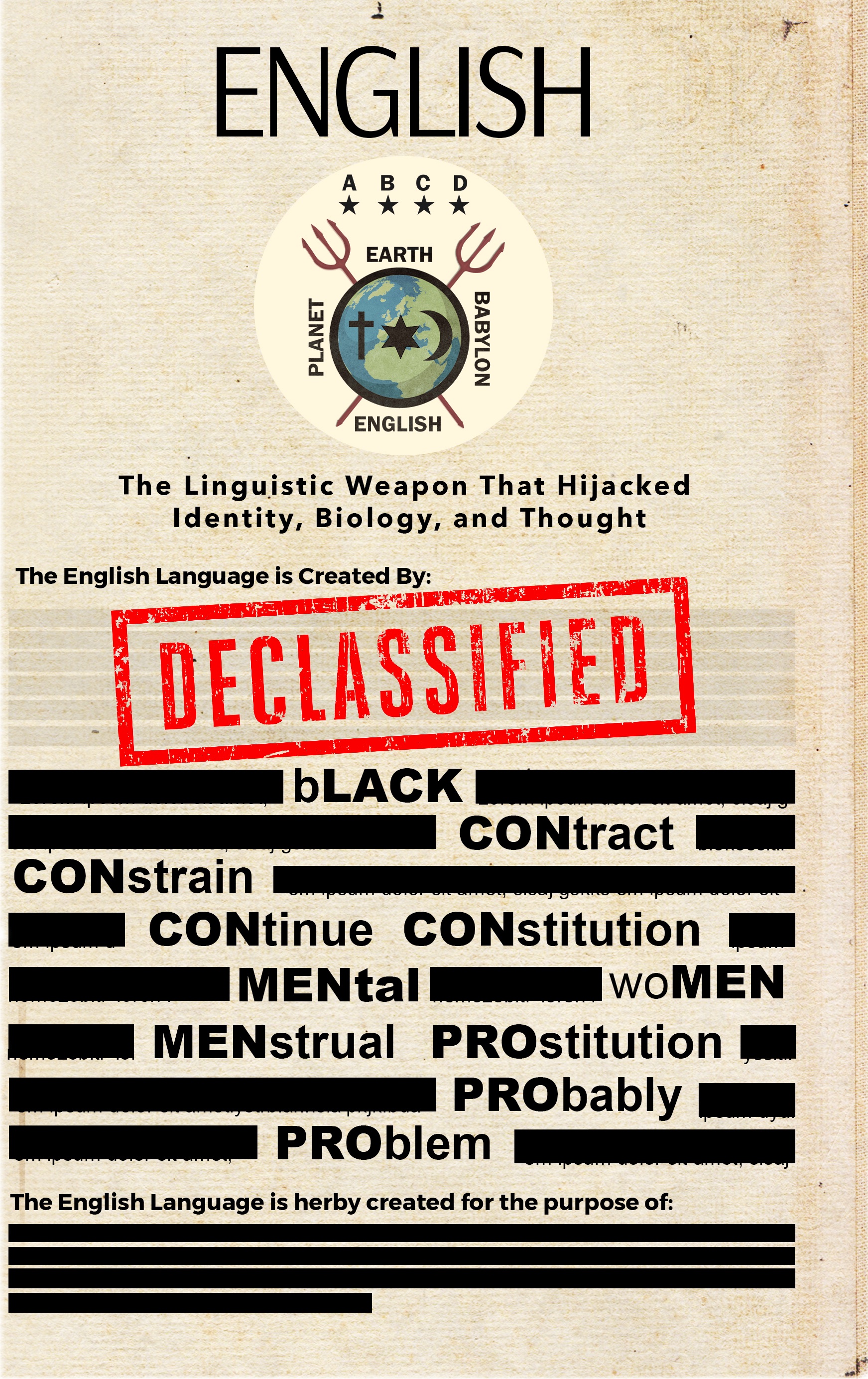
English Declassified
Why a Grammatical Sentence Is Also a Judge's Sentence
Digital Copy
$13.00 USD
Instant digital access — ebook PDF.
Digital + Audio
$40.00 USD
Instant digital access — ebook PDF plus full audiobook.
Physical Book
$144.00 USD
Premium archival paperback, ships worldwide.
English Declassified starts from one exact fact: "sentence" means two different things in English — a grammatical unit, and a judge's punishment — and they're not supposed to be related. The book takes that seriously. A subject is read the way a courtroom reads a defendant. A predicate, literally "pre-determined," is already decided before you finish the thought. From there, the book runs the same rigorous method across the entire alphabet: twenty-six chapters, each checking a letter's real definition, etymology, phonetics, and first/last dictionary entries against the rules it seems to be following. Underneath all twenty-six sits a second structure — a number system connecting letters by shared digital root instead of alphabet position, with its own dedicated section explaining how it works (A, J, and S share root 1; the words ADJUSTMENT and JOURNALIST prove the connection twice over, both containing all three letters and reducing to that same root by length). This is the technical manual: the rules, the code running underneath them, and the reasons no one ever explained either to you.
Key Topics Covered
- Grammar as Law — subject as defendant, predicate as pre-determined, verb as verdict: the courtroom vocabulary hiding inside ordinary sentence structure
- Real Etymology — where each letter actually comes from, traced to a citable origin, not folk explanation
- The Number Behind the Alphabet — a numerical structure connecting letters by shared digital root, not alphabet position, with its own dedicated breakdown
- Letter Symbolism — shape, position, and cultural reading: what a letter does beyond what it means alone
Who This Book Is For
This book is for anyone who has ever noticed a strange overlap in English — that a "sentence" is also a punishment, that being "objectified" comes straight from "object" — and wanted to know if that was actually significant. No linguistics background required: every claim is checked against real dictionary, etymological, and phonetic data and explained in plain language as it's found.
Excerpt
The language sentenced the world to life on earth.
Frequently Asked Questions
What does "a sentence is also a judge's sentence" actually mean?+
It means the book treats that overlap as real evidence, not a pun. A subject is read the way a courtroom reads a defendant. A predicate — literally "pre-determined" — is already decided before the sentence is finished. The book builds that argument out in full, then checks it against real grammar and real etymology rather than leaving it as wordplay.
Is this real etymology, or wordplay?+
Real etymology and real dictionary data. Every claim about a letter's origin, definition, or pronunciation is checked against real sources. Where the book makes an argument about language and power, that argument is kept separate from — and built on top of — the verified technical material, not blended into it.
What's the number system running under the alphabet?+
Every letter has a position in the alphabet, and every position reduces to a single digit (its "digital root") — A is 1, J is 10 (1+0=1), S is 19 (1+9=10, 1+0=1). Letters that share a root get grouped together, revealing connections the alphabet's own A-to-Z order hides. A, J, and S all share root 1 — and the words ADJUSTMENT and JOURNALIST both contain all three letters and are themselves 10-letter words (which also reduces to 1), a double-confirmation the book uses as its flagship example.
Do I need a linguistics or legal background to read this?+
No. Every claim is explained in plain language as it's found — the book is written to be read cover to cover, not referenced like a textbook.
How is the book organized?+
The central argument (grammar as a legal system) runs through the whole book, alongside twenty-six chapters — one per letter — each covering that letter's real definition, etymology, phonetics, and first/last dictionary entries. The numerical root system that connects letters across the alphabet gets its own dedicated section.
What formats are available?+
English Declassified is available as a digital edition with instant access.
Is this the whole project?+
English Declassified is the technical volume — the rules, and the code inside them. It's the first of a planned series; future books go further into what those rules actually encode.